HVAC Marketing: 15 Strategies That Book Jobs in 2026
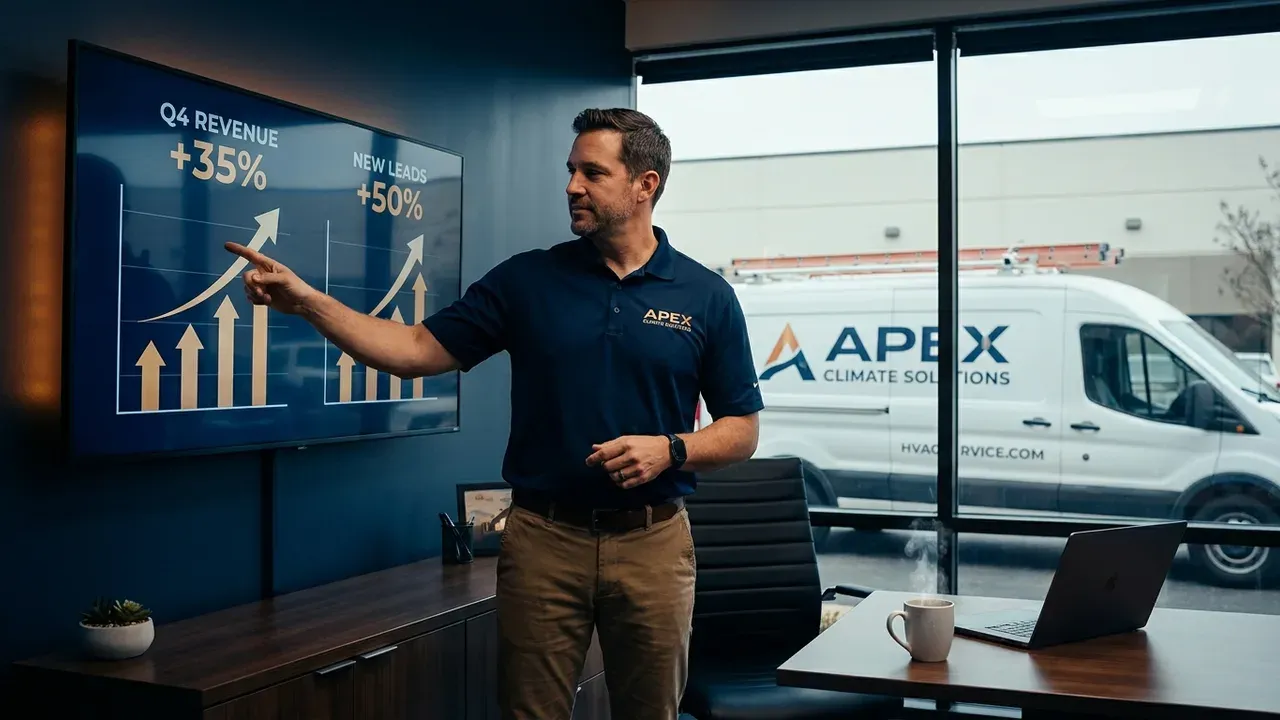
HVAC marketing is the work of getting your company in front of homeowners at the three moments they need you: when a system fails, when they are planning a replacement, and when it is time for maintenance. Each moment calls for a different channel. The 15 strategies below are grouped by job: get found, win the call, keep the customer, and show up offline. Then you get a seasonal calendar, a budget planner and a checklist you can work through this quarter.
Key takeaways
- Local search (your Google Business Profile plus a website with service and city pages) is the base. Paid channels fill gaps while it grows.
- Reviews are a system, not a favor you ask for once in a while. Recency matters to homeowners.
- Your past-customer list and maintenance agreements are the cheapest way to smooth out the slow months.
- Judge every channel by cost per booked job, not traffic.
Marketing for HVAC companies: what has to happen
Before picking tactics, it helps to know what HVAC marketing has to handle. Demand is seasonal and weather-driven. A lot of it is urgent (“AC not cooling,” “furnace won’t turn on”), and the rest is high-ticket and planned (a system replacement, a heat pump conversion). A homeowner with no heat at 10 p.m. will call the first credible company they find. A homeowner comparing replacement quotes will read reviews, check your site, and ask about financing.
So your marketing has to do two things at once: capture urgent demand fast, and build the trust that wins planned, higher-value work. The strategies below cover both.
Part 1: Get found
1. Complete and verify your Google Business Profile
For “AC repair near me” and “HVAC company [city],” the map results usually sit above the regular results. Google says local ranking comes down to three factors: relevance, distance and prominence (Google Business Profile Help). You can’t change distance, but you control a lot of relevance and prominence:
- Primary category that describes what your business is (for example “HVAC contractor”), plus a small number of accurate secondary categories. Google’s guidelines say to use as few categories as possible (GBP guidelines).
- Service area set to the cities or ZIP codes you actually serve. If you work from a shop customers don’t visit, Google says service-area businesses should hide their address.
- Real business name only. Adding “Best AC Repair Dallas” to your name breaks Google’s guidelines and can get the profile suspended. If you’re still choosing a name, our HVAC company names guide shows how to build “Heating & Air” into the real name instead.
- Services, hours, photos and videos of your real trucks, techs and installs. Keep them current.
- Replies to reviews. Google’s own ranking tips mention that replying to reviews shows you value feedback.
2. Test Local Services Ads
Local Services Ads (LSAs) show at the top of many service searches. Google charges per lead (a call, message or booking) rather than per click, and businesses that pass Google’s screening can show the Google Verified badge (Local Services Ads Help). For HVAC, LSAs often suit urgent repair demand. Set your job types and service area carefully, answer every lead fast, and dispute leads that clearly fall outside your services.
3. Build a website that works like a dispatcher
Your website has one job: turn a visit into a call or booking. On an HVAC site, that means:
- Tap-to-call phone number in the header of every page, plus a sticky call button on mobile.
- A visible “24/7 emergency service” banner, if you actually offer it.
- A short request form (name, phone, ZIP, issue) and online booking if your scheduling software supports it.
- Trust blocks: license number, insurance, financing options, warranties, and the certifications your techs hold. Under EPA rules, technicians who work on equipment that could release ozone-depleting refrigerants must be certified (EPA Section 608). Saying your techs are 608-certified is a simple, true trust signal.
- Fast load on a phone. Many emergency searches happen on mobile, and a slow page costs you the call.
If you’re starting from scratch, HVAC website design covers the build, and how much an HVAC website costs breaks down the budget.
4. Create one page per service and per service area
One “Services” page can’t rank for everything. Build separate pages for AC repair, AC installation, furnace repair, furnace replacement, heat pumps, ductless mini-splits, maintenance plans and indoor air quality. Then add service-area pages for the cities you serve, each with real local detail (neighborhoods, common housing stock, local permit notes, reviews from that area), not the same text with the city name swapped.
Example title tags and meta descriptions:
| Page | Title tag | Meta description |
|---|---|---|
| AC repair | AC Repair in Plano, TX, Same-Day Service | Brand | Licensed techs, upfront pricing and same-day AC repair across Plano and Allen. Call now or book online in under a minute. |
| Furnace replacement | Furnace Replacement in Denver | Free In-Home Estimate | Brand | Compare high-efficiency furnace options, financing and warranties. Free in-home estimate from our Denver team. |
| Service area | HVAC Company in Frisco, TX | Repair, Install, Maintenance | Brand | Heating and cooling repair, replacement and maintenance plans for Frisco homeowners. See reviews from your neighbors. |
Keep each one specific to the page. Google’s documentation warns against boilerplate titles repeated across pages.
5. Publish content that answers real homeowner questions
Homeowners search questions like “why is my AC blowing warm air,” “how long does a furnace last,” “heat pump vs furnace,” and “how much does a new AC unit cost.” Honest answers, with a clear next step on the page (“book a diagnostic”), bring in people early in the buying cycle and give your service pages internal links. Aim for one strong, specific article a month rather than a burst of thin posts. The local SEO guide for home service businesses covers how content fits with the rest of your local SEO.
6. Run Google Search ads for the jobs you want most
LSAs give you less control. Standard Google Search ads let you pick keywords, write your own ads, and send traffic to a specific landing page. Use them for high-value work like replacements and heat pump installs, add negative keywords (jobs, DIY, parts, “free”), and schedule ads around your call-handling hours. The full setup is in Google Ads for contractors.
Part 2: Win the call
7. Turn reviews into a system
Reviews affect both ranking (prominence) and whether a homeowner calls. BrightLocal’s 2026 Local Consumer Review Survey found that 97% of consumers read reviews for local businesses, 74% look for reviews written in the last three months, and 83% of people who wrote a review did so after the business asked (BrightLocal).
The system:
- Send a review link by text within a few hours of every completed job. Most field service software can automate this.
- Name the tech in the message; customers remember people.
- Reply to every review, positive or negative, in your own words.
- Never offer discounts or gifts for reviews. Google’s policy prohibits incentives for reviews.
Scripts and timing are in how to get more Google reviews.
8. Answer fast and follow up faster
A lead that waits often calls the next company on the list. Set a response-time goal for calls, forms and LSA messages, route after-hours calls to an answering service or on-call tech, and follow up on unsold replacement quotes. Field service platforms such as ServiceTitan, Housecall Pro and Jobber include scheduling, dispatch and automated customer messages. Jobber, for example, lists online booking, automated quote follow-ups and post-job review requests among its features. Use what your software already has before buying another tool.
9. Make financing and pricing easy to understand
Replacement buyers compare. Publish what you can: diagnostic fee, maintenance plan price, financing options and what affects a replacement quote (system size, efficiency rating, ductwork, permits). You don’t have to list full install prices, but explaining how you price builds trust with people deciding between three quotes.
Part 3: Keep the customer
10. Sell maintenance agreements
Maintenance plans give you recurring revenue, predictable shoulder-season work and a reason to see the system twice a year, which is when you spot aging equipment before it fails. Give the plan its own page, describe what’s included in plain language, and offer it on every service call.
11. Email and text your past customers
Your customer list is the cheapest audience you have. Send a short reminder before each season (“book your fall heating check”), a filter-change reminder, and a note to anyone whose system is near the end of its expected life. Keep it useful and infrequent. One relevant message per season beats a weekly newsletter nobody reads.
12. Build a referral loop
Ask happy customers for referrals at the moment they’re happiest: right after a repair that saved their weekend or a clean install. Also build relationships with real estate agents, home inspectors and property managers, who get asked “who do you use for HVAC?” all the time.
Part 4: Show up offline
13. Wrap your trucks and use yard signs
Your vans drive through your service area every day. A clean wrap with your name, phone, website and one clear line (“Heating and cooling, same-day service”) works as a moving billboard. Ask permission to put a yard sign on the lawn for a few days after an install. Neighbors notice.
14. Mail the neighbors of your recent installs
After a replacement, send a postcard or door hanger to the surrounding homes. Nearby houses often have similar-age systems. Put a tracked phone number or QR code on the piece so you can measure it.
15. Track cost per booked job
Every strategy above only matters if you can see what it produces. Use call tracking with separate numbers per channel, UTM tags on ad and email links, and a “how did you hear about us?” field in your booking flow. Once a month, work out spend, booked jobs, cost per booked job and average ticket by channel. Keep what pays and cut what doesn’t. For more lead-generation tactics, see how to get more HVAC leads.
How to market your HVAC business through the year
HVAC demand swings with the weather, so plan campaigns a season ahead. Adjust the months to your climate.
| Season | Demand pattern | What to run |
|---|---|---|
| Late winter (Feb to Mar) | Heating repairs taper, cooling not yet started | Fix website and GBP, publish replacement content, recruit techs before peak |
| Spring (Mar to May) | Pre-season cooling checks | AC tune-up campaign to your list, maintenance plan push, increase ad budgets as temperatures rise |
| Summer (Jun to Aug) | Peak cooling and emergency calls | Emergency-focused LSAs and search ads, fast response, review requests after every job |
| Early fall (Sep to Oct) | Shoulder season | Furnace tune-up campaign, follow up on aging-system notes from summer calls, neighbor mailers |
| Late fall and winter (Nov to Jan) | Heating calls and no-heat emergencies | Heating-focused ads, maintenance renewals, year-end financing offers if you have them |
Budget planning by channel
There is no correct HVAC marketing budget that fits every company. The table below is a planning template, not a benchmark. It shows one way to split a hypothetical monthly budget for a small residential HVAC company that already has a working website. Assumptions: a single metro, 2 to 6 trucks, and the owner or office staff handling review requests and email in-house.
| Channel | Share of monthly budget (planning range) | What you’re paying for | How to judge it |
|---|---|---|---|
| Local Services Ads | 20 to 35% | Per-lead urgent demand | Cost per booked job, share of disputable leads |
| Google Search ads | 20 to 35% | High-value replacement and install searches | Cost per booked job, average ticket |
| SEO and content | 15 to 25% | Service and city pages, articles, GBP upkeep | Organic calls and forms over 6 to 12 months |
| Email, SMS and review tools | 5 to 10% | Past-customer campaigns, automated review requests | Rebooking rate, reviews per month |
| Offline (wraps, signs, mailers) | 5 to 15% | Local visibility and install-neighborhood mailers | Tracked calls and QR scans |
Change the mix once you have 60 to 90 days of your own cost-per-booked-job data. Your numbers beat any template.
Marketing your HVAC company: a checklist
| Item | Done? |
|---|---|
| Google Business Profile verified, correct primary category, service area set | |
| Business name matches real-world name (no keywords added) | |
| Separate pages for each core service and main service areas | |
| Unique title tag and meta description on every page | |
| Tap-to-call on mobile, form under 5 fields, online booking if available | |
| License, insurance, EPA 608 certification and financing shown on site | |
| Automated review request after every job; every review answered | |
| Call tracking and UTM tags on every paid and email link | |
| Seasonal tune-up campaigns scheduled for spring and fall | |
| Maintenance plan page and offer on every service call | |
| Trucks wrapped; yard-sign and neighbor-mailer process in place |
A note on hiring: marketing for technicians
Marketing only helps if you can run the calls it brings in. The US Bureau of Labor Statistics projects employment of HVAC mechanics and installers to grow 11% from 2025 to 2035, with about 40,600 openings a year (BLS). Competition for good techs is real. Treat recruiting as its own campaign: a careers page with real pay ranges and benefits, photos of your crew and trucks, and job posts that go out before peak season, not during it.
Putting it together
Start with the base: a complete Google Business Profile, a fast site with service and city pages, and a review system that runs after every job. Add one paid channel and track it by booked jobs. Work your customer list and maintenance plans in the shoulder seasons, and let trucks, signs and mailers keep your name visible in the neighborhoods you already serve.
If your website is what’s holding the rest back, see our HVAC website design service or message us for a fixed quote.
Our service
HVAC website design
What's included, how it works, and pricing.
Sources
- Google Business Profile Help: Tips to improve your local ranking on Google
- Google Business Profile Help: Guidelines for representing your business on Google
- Google Local Services Ads Help: About Local Services Ads
- BrightLocal: Local Consumer Review Survey 2026
- US EPA: Section 608 Technician Certification
- US Bureau of Labor Statistics: Heating, Air Conditioning, and Refrigeration Mechanics and Installers
Frequently asked questions
What is the best marketing for HVAC companies? +
There is no single best channel, but the strongest base for most HVAC companies is a complete Google Business Profile, a fast website with one page per service and service area, a steady flow of recent reviews, and a paid channel (Local Services Ads or Google Search ads) for demand you need right now. Offline tactics like truck wraps and neighbor mailers support that base; they rarely replace it.
How do I market my HVAC business with a small budget? +
Start with the free and owned channels: complete and verify your Google Business Profile, ask every finished customer for a review, and email or text your past-customer list before each season. Then add one paid channel, track cost per booked job for 60 to 90 days, and only scale what books work at a margin you can live with.
How much should an HVAC company spend on marketing? +
There is no universal right number. Set a monthly budget you can sustain for at least six months, split it between channels that capture existing demand (ads, Local Services Ads) and channels that compound (SEO, reviews, your customer list), and judge each one by cost per booked job and average ticket, not by clicks or impressions.
How do HVAC companies get more customers in the off-season? +
Sell maintenance agreements, run pre-season tune-up campaigns to your own list in spring and fall, follow up on repair customers whose systems are near the end of their life, and publish content that answers replacement questions. The shoulder seasons are also the right time to fix your website and Google profile before peak demand arrives.
Are Local Services Ads worth it for HVAC? +
They are worth testing. Google charges Local Services Ads per lead rather than per click, and businesses that pass Google's screening can show a Google Verified badge. Results vary by market and competition, so treat the first few months as a test and dispute leads that fall outside your services.
Want a website that gets you more jobs?
Message us on WhatsApp and our team will send a free quote and a clear plan to get your phone ringing with new customers.
Get a free quoteKeep reading
-
HVAC Company Names: 120 Ideas + a 5-Step Name Check
120 original HVAC company name ideas in 7 styles, a name-formula table, and a 5-step check (state, USPTO, domain, socials, Google) to run before you commit.
-
HVAC Slogans: 100 Lines for Trucks, Ads & Your Website
100 original HVAC slogans sorted by where you use them: Google Ads headlines under 30 characters, truck wraps, website heroes, yard signs and seasonal promos.
-
Electrician Marketing: Plan by Job Type, Not by Channel
Electrician marketing for 2026, planned around the jobs you want: emergency calls, panel upgrades, EV chargers, generators and remodel work. What each customer searches, and the page and channel that wins it.