Contractor Marketing: 17 Ideas That Win More Jobs in 2026
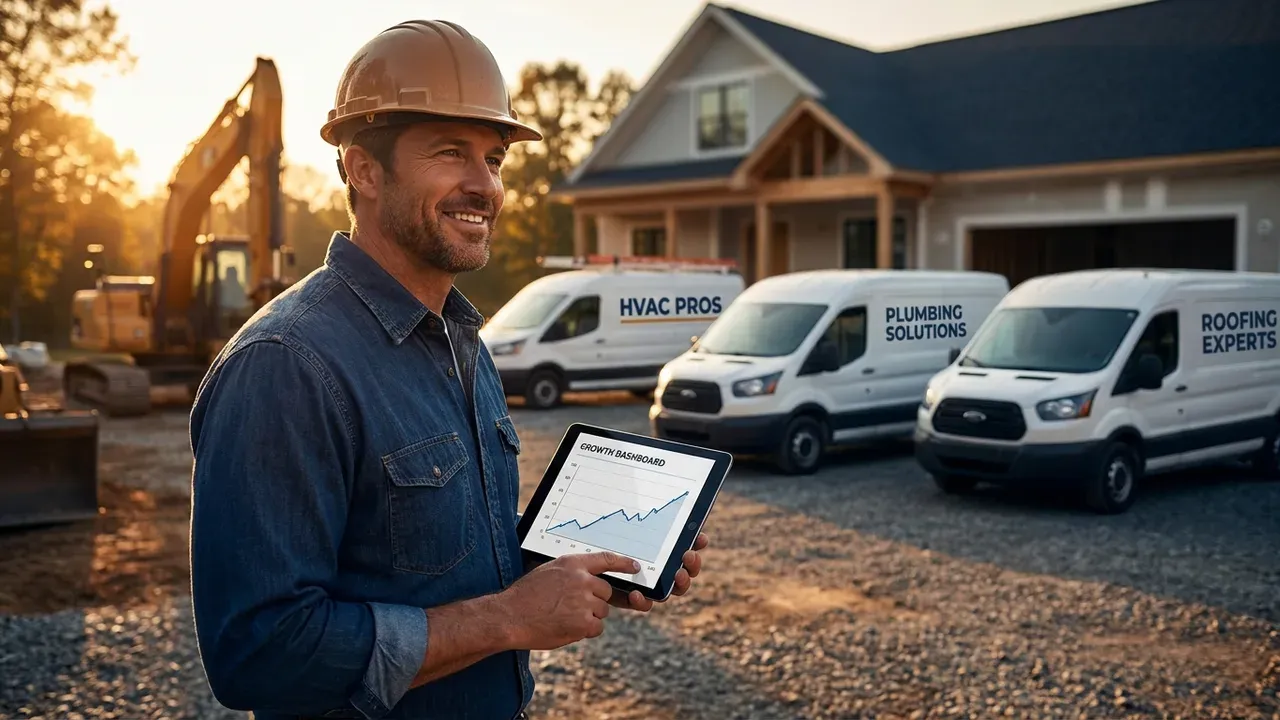
Contractor marketing is how a trade or home improvement business gets found, chosen and hired, and ideally how it gets steady, profitable work instead of feast-or-famine months. The contractors who win usually aren’t the loudest. They’re the easiest to find, the easiest to trust, and the fastest to answer. Below are 17 contractor marketing ideas grouped into digital foundations, offline tactics, conversion and follow-up, and recruiting, plus a budget planner and checklist. They apply to roofing, HVAC, plumbing, electrical, remodeling and general contracting.
Key takeaways
- Your Google Business Profile and a website with service and service-area pages are the base. Everything else builds on them.
- Offline tactics (yard signs, truck wraps, neighbor mailers) still work when you tie them to the jobs you’re already doing.
- Speed-to-lead and quote follow-up often recover more revenue than new ad spend.
- Recruiting is marketing too. You can’t sell jobs you don’t have crews for.
What contractor marketing is (and what it isn’t)
Contractor marketing isn’t a logo, a Facebook page, or buying leads and hoping. It’s the full path from “homeowner has a problem” to “signed job.” That path has four stages: found (search, maps, referrals, signs), chosen (reviews, photos, website, pricing clarity), contacted (easy calling, forms, booking), and closed (fast response, a professional quote, follow-up). Most contractors put money into the first stage and leak jobs in the other three.
Part 1: Digital foundations
1. Own your Google Business Profile
When someone searches “[trade] near me,” the map results usually show first. Google says local ranking is based on relevance, distance and prominence, and that complete, accurate information and reviews help (Google Business Profile Help). Verify your profile, choose the most accurate primary category, set your real service area, add photos of actual jobs and crews, and reply to every review.
2. Build a website that books estimates
A contractor website should work like your best salesperson on the phone:
- Phone number and “Get a free estimate” button in the header of every page.
- One page per service (roof replacement, roof repair, gutters, siding) instead of a single “Services” page.
- Before-and-after photo galleries of real work, labeled by job type and neighborhood.
- License number, insurance, warranties and financing clearly shown.
- A short estimate form that works well on a phone.
For roofers, see roofing website design. HVAC, plumbing and electrical contractors have trade-specific pages too.
3. Create service-area pages with real local detail
Ranking in one town doesn’t mean you rank in the next one over. Build a page for each main city you serve, and make each one different: projects you’ve completed there, local permit or HOA notes, housing stock and common problems, and reviews from customers in that area. Pages that only swap the city name add little and tend not to hold rankings.
4. Make reviews a weekly habit
BrightLocal’s 2026 survey found 97% of consumers read reviews for local businesses and 74% look for reviews from the last three months. It also found 83% of people who wrote a review did so after being asked (BrightLocal). Text a review link after every completed job, reply to every review, and never offer incentives for reviews, which Google prohibits. Scripts and timing: how to get more Google reviews.
5. Use Local Services Ads for urgent work
Local Services Ads appear at the top of many service searches and charge per lead rather than per click. Businesses that pass Google’s screening can show a Google Verified badge (Local Services Ads Help). They fit best for urgent, common jobs. Answer leads quickly, keep your job types and service area tight so you only pay for work you want, and dispute leads that fall outside your services.
6. Run Google Search ads for high-value jobs
Search ads give you control over keywords, ad copy and landing pages, which makes them a good fit for high-ticket work like full replacements and remodels. Use tight keyword themes, strong negative keywords (“jobs,” “DIY,” “salary,” “cheap”), and a dedicated landing page per service. The setup is in Google Ads for contractors.
7. Publish content that answers buying questions
“How much does a new roof cost,” “repair or replace,” “how long does a bathroom remodel take,” “what permits do I need.” Honest, specific answers bring in homeowners who are still deciding and build trust before the first call.
8. Claim your listings beyond Google
Claim and complete Bing Places, Apple Business Connect, Yelp, the BBB, Nextdoor and your trade associations. Keep your business name, address and phone number identical everywhere. These listings bring some direct leads and help search engines confirm who you are.
Part 2: Offline tactics for contractors
9. Yard signs on every job
Ask for permission to place a sign during and after the job. Neighbors see work happening, and a sign with your name, phone number and trade answers “who’s doing that?” on the spot.
10. Truck and trailer wraps
Your vehicles spend all day in your service area. Keep the design simple: name, trade, phone, website. A wrap nobody can read at 35 mph is wasted money. If you need the line itself, our HVAC slogans are sorted by placement, including short wrap lines that read at a glance.
11. Neighbor mailers and door hangers
After a job, drop door hangers or send postcards to the surrounding homes: “We just finished a roof replacement on your street.” Homes in one neighborhood are often similar in age and construction, so they tend to need similar work. Use a tracked number or QR code to measure it. USPS Every Door Direct Mail lets you target mail by carrier route without buying a list.
12. Referral partners
Real estate agents, home inspectors, property managers, insurance agents and suppliers all get asked for contractor recommendations. Meet them, make it easy to refer you (a card, a direct line, fast response), and thank them every time.
13. Home shows and community sponsorships
A booth at a local home show or a sponsored youth team won’t produce leads overnight, but it builds local name recognition and often earns a link from a local website, which also helps local search.
Part 3: Convert and follow up
14. Answer fast
A homeowner who can’t reach you often calls the next contractor on the list. Set response-time goals for calls, forms and messages, route after-hours calls to an answering service, and track missed calls every week.
15. Follow up on every quote
Many quotes die from silence, not price. Send a follow-up a few days after the quote, then another a week later, and offer to answer questions or adjust scope.
Marketing for Jobber, Housecall Pro and ServiceTitan contractors
If you already run your business on field service software, use its marketing features before you buy anything else. Jobber lists online booking (on your website, Google Business Profile or a shared link), automated quote follow-ups, and automated Google review requests after jobs among its features. Housecall Pro and ServiceTitan offer similar booking, messaging and review tools depending on your plan. The practical steps:
- Put the booking or request link on your website and Google Business Profile.
- Turn on automated quote follow-ups.
- Trigger review requests when a job is marked complete.
- Use customer tags (job type, install date) to send seasonal or maintenance reminders.
16. Track cost per booked job
Use separate tracked phone numbers per channel, UTM tags on ad and email links, and a “how did you hear about us?” question. Once a month, compare each channel’s spend, booked jobs, cost per booked job and average job value. Cut what doesn’t book work.
Part 4: Home improvement contractor recruitment marketing
17. Market your jobs the way you market your services
Growth needs crews. The US Bureau of Labor Statistics projects about 42,000 openings a year for plumbers, pipefitters and steamfitters (BLS) and about 40,600 a year for HVAC mechanics and installers (BLS) through 2035. You’re competing for the same people as every other contractor in town.
A recruiting marketing plan:
- A real careers page. Pay ranges, benefits, schedule, tools and vehicle policy, training path, and photos of your actual crew. Vague posts get vague applicants.
- Job posts marked up for Google. JobPosting structured data can make your openings eligible for Google’s job search experience. Google lists base salary as a recommended property (Google Search Central).
- Employee referral bonuses. Your best techs know other good techs.
- Trade school and apprenticeship partnerships. Offer shop visits, ride-alongs and guest talks.
- Show the work culture. Short videos of real jobs and crew days on social media reach both customers and future hires.
- Hire before your busy season. Posting during peak demand means competing when everyone is hiring.
Contractor marketing trends for 2026
- AI-assisted search. BrightLocal’s 2026 survey reports 45% of consumers now use AI tools like ChatGPT for local business recommendations. Clear service pages, consistent listings and plenty of reviews give those tools accurate information about you.
- Review recency and response. The same survey found 80% of consumers say they’d use a business that responds to all its reviews.
- Automation for small crews. Booking, quote follow-up and review requests that used to need an office manager now come built into most field service software.
- Verification badges. Google’s Local Services Ads screening and badge give homeowners a quick trust signal at the top of the results.
Contractor marketing by trade
The 17 ideas apply across trades, but each trade leans on a different mix.
- Roofing. Demand spikes after storms, and many jobs involve insurance claims. Build a storm-damage page explaining the inspection and claims process, respond quickly after local weather events, and lean on yard signs and neighbor mailers, since roofs on one street often share age and storm exposure. More in how to get more roofing leads.
- HVAC. Seasonal and weather-driven. Maintenance agreements and pre-season tune-up campaigns to your own customer list smooth out the slow months. See HVAC marketing.
- Plumbing. Heavily urgent. A dedicated emergency page, accurate hours on your Google profile and fast call answering matter more than almost anything else. See plumbing SEO.
- Electrical. Split between service calls and projects like panel upgrades, EV chargers and generators. Give each project type its own page and show your license number prominently. See electrician marketing.
- Remodeling and general contracting. Long sales cycles and high trust requirements. Detailed project galleries, a clear explanation of your process and timeline, and consistent follow-up on estimates do most of the work.
A 90-day contractor marketing plan
Month 1: foundation. Verify and complete your Google Business Profile, fix the call and estimate buttons on your website, start review requests after every job, and set up tracked phone numbers.
Month 2: pages and paid. Build your top three service pages and one or two service-area pages with real project photos. Launch one paid channel (Local Services Ads or Google Search ads) with a small, fixed budget.
Month 3: offline and follow-up. Put yard signs and neighbor mailers on every job, turn on quote follow-ups in your software, and review cost per booked job by channel to decide where next quarter’s money goes.
Budget planning by channel
There’s no universal contractor marketing budget. This table is a planning template, not an industry benchmark. It assumes a small residential contractor in one metro, a working website, and in-house handling of reviews and follow-up. Replace it with your own data after 60 to 90 days.
| Channel | Share of monthly budget (planning range) | Best for | Measure by |
|---|---|---|---|
| Google Search ads | 25 to 40% | High-value, planned jobs | Cost per booked job, average ticket |
| Local Services Ads | 15 to 30% | Urgent, common jobs | Cost per booked job, lead quality |
| SEO, content, GBP upkeep | 15 to 25% | Compounding organic calls | Organic calls and forms over 6 to 12 months |
| Offline (signs, wraps, mailers) | 10 to 20% | Local visibility near jobs | Tracked calls, QR scans |
| Reviews, email and SMS tools | 5 to 10% | Reviews and repeat work | Reviews per month, repeat bookings |
| Recruiting | As needed | Crew capacity | Qualified applicants, hires |
Contractor marketing checklist
| Item | Done? |
|---|---|
| Google Business Profile verified, correct category, real service area | |
| Website with a page per service and main service areas | |
| Before-and-after galleries of real work | |
| License, insurance and warranty shown | |
| Review request sent after every job; every review answered | |
| Listings claimed on Bing, Apple, Yelp, BBB, Nextdoor | |
| Yard sign and neighbor-mailer process on every job | |
| Tracked phone numbers per channel | |
| Quote follow-up automated | |
| Careers page with real pay ranges; job posts marked up |
Where to start
If you do only three things this month: complete your Google Business Profile, start sending a review request after every job, and fix the part of your website that makes it hard to call or request an estimate. Then add one paid channel and track it.
For plumbers, the broader mix beyond search is in plumber marketing. If you need a site built to book estimates, see roofing website design or message us for a fixed quote.
Our service
Roofing website design
What's included, how it works, and pricing.
Sources
- Google Business Profile Help: Tips to improve your local ranking on Google
- Google Local Services Ads Help: About Local Services Ads
- BrightLocal: Local Consumer Review Survey 2026
- Google Search Central: Job posting (JobPosting) structured data
- US Bureau of Labor Statistics: Plumbers, Pipefitters, and Steamfitters
- US Bureau of Labor Statistics: Heating, Air Conditioning, and Refrigeration Mechanics and Installers
Frequently asked questions
What is contractor marketing? +
Contractor marketing is everything a trade or home improvement business does to get found, chosen and hired: your Google Business Profile, website, reviews, ads, referrals, yard signs, truck wraps and follow-up. Good contractor marketing is measured in booked jobs and margin, not clicks.
What are the biggest contractor marketing trends in 2026? +
Three stand out. Homeowners increasingly use AI tools alongside search to find local businesses, so clear, specific service pages matter more. Review recency carries more weight with consumers. And field service software now automates booking, quote follow-up and review requests, which makes speed-to-lead easier for small crews.
How do Jobber contractors do marketing inside the software? +
Jobber lists online booking, automated quote follow-ups and automated Google review requests among its features. Connect online booking to your website and Google Business Profile, turn on quote follow-ups, and trigger review requests when a job closes. Housecall Pro and ServiceTitan offer similar tools; check which ones your plan includes.
How do home improvement contractors recruit through marketing? +
Treat hiring as a campaign. Build a careers page with real pay ranges, benefits and crew photos, mark up job posts with JobPosting structured data so they can appear in Google's job search experience, run an employee referral bonus, and partner with local trade schools and apprenticeship programs.
How much should a contractor spend on marketing? +
There is no single correct figure. Pick a monthly budget you can hold for six months, split it between channels that capture demand now (ads) and channels that compound (SEO, reviews, referrals), then shift money based on cost per booked job and average job value from your own tracking.
Are lead-generation sites like Angi worth it for contractors? +
They can fill gaps, especially for a new business, but you're renting leads on someone else's platform. Use them as a supplement, track the close rate against leads from your own website and Google profile, and keep putting money into channels you own.
Want a website that gets you more jobs?
Message us on WhatsApp and our team will send a free quote and a clear plan to get your phone ringing with new customers.
Get a free quoteKeep reading
-
Electrician Marketing: Plan by Job Type, Not by Channel
Electrician marketing for 2026, planned around the jobs you want: emergency calls, panel upgrades, EV chargers, generators and remodel work. What each customer searches, and the page and channel that wins it.
-
11 Dental Marketing Ideas That Fill Your Schedule (2026)
Dental marketing ideas organised by the patient journey: get found, get chosen, get booked, and bring patients back. Includes the privacy rule most practices get wrong when replying to reviews.
-
Google Ads for Contractors: Setup Order and the Math
A step-by-step Google Ads setup for contractors in 2026: Local Services Ads vs Search, a negative keyword starter list, landing pages, and how to calculate cost per booked job before you spend.