Plumber Marketing: The Burst-Pipe Test for Every Channel
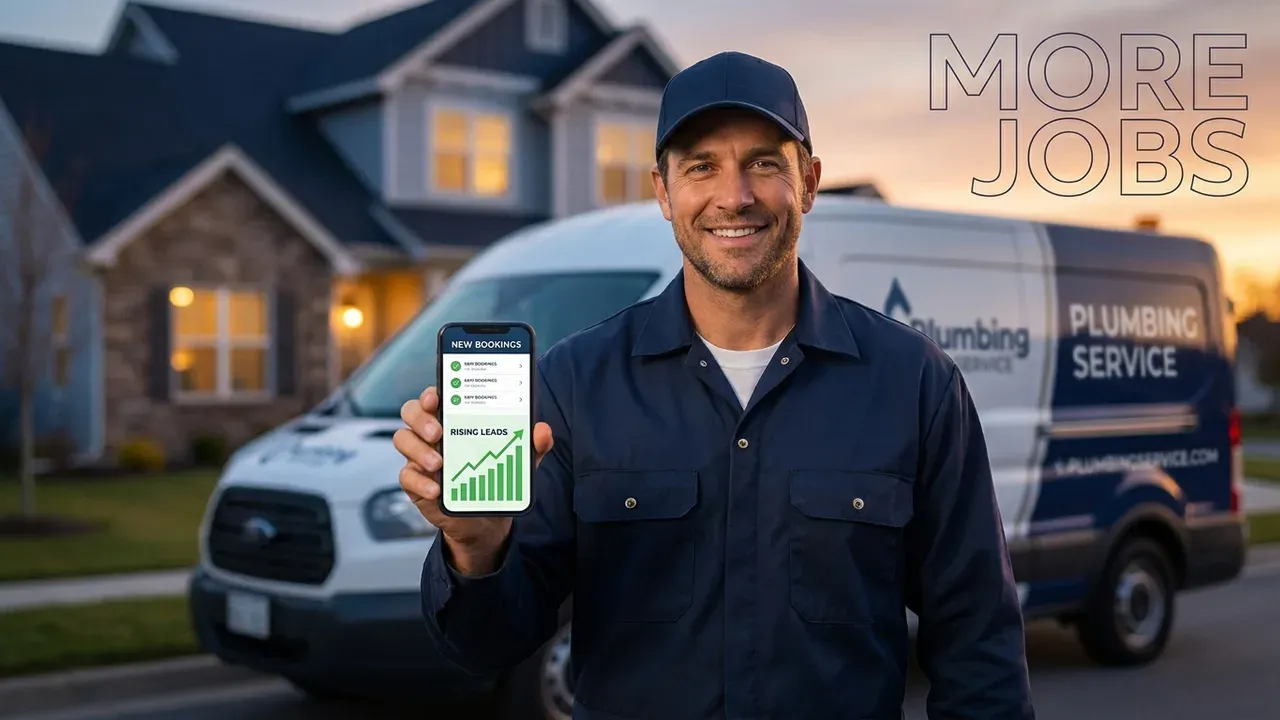
Here’s a test worth running on your own business. Imagine it’s a Sunday night, a pipe under the kitchen sink has burst, and the homeowner is standing in water with a phone. Follow them step by step and see where they would drop off. Every step where they could leave is a marketing problem, and most of them are cheaper to fix than buying more leads.
Step 1: The search
They type “emergency plumber” or “plumber near me.” What shows up is usually ads at the top, then the map results, then websites.
What to check:
- Search for your main services from a phone in your service area. Do you appear in the map results? In ads?
- Is your Business Profile verified, with the “Plumber” primary category, accurate service areas, and real photos?
- If you work from home, is your address hidden? Google’s Business Profile guidelines specifically use a plumber working from a residential address as the example of a service-area business that should hide it.
- Is your business name your real name, with no “24/7 Emergency Plumber [Town]” added? The same guidelines say extra keywords in the name aren’t permitted.
Our Google Maps ranking audit goes through every profile field.
Step 2: The first impression
They see your listing next to two or three others. In a few seconds they judge: star rating, number and recency of reviews, whether you look open, whether there are real photos.
What to check:
- Are your hours accurate? If you advertise after-hours service, does someone actually answer?
- When was your last review? A steady flow matters more than a big old total. Our reviews guide has scripts for asking on every job.
- Do your photos show your vans, uniforms and team, or only a logo?
Step 3: The ad option
If you run Local Services Ads, you appear above the map results for many plumbing searches. Google charges per valid lead, such as an answered call or a message, not per click. Screened businesses show the Google Verified badge, which replaced Google Guaranteed in October 2025.
What to check:
- Are your LSA hours the hours you can answer?
- Are you disputing leads that clearly aren’t valid (wrong service, outside your area)?
- Do you know your cost per booked job from LSAs, not just cost per lead?
For Search Ads setup, negatives and landing pages, see Google Ads for contractors.
Step 4: The website visit
Some homeowners call straight from the listing. Others tap through to your website to check you’re real. They’re on a phone, stressed, and probably on a weak connection.
What to check:
- Speed on a phone. Run your site through PageSpeed Insights. Google’s Core Web Vitals targets are LCP within 2.5 seconds, INP under 200 milliseconds and CLS under 0.1. A slow page loses people before they see your number.
- The phone number is tappable, at the top of every page, and doesn’t move as the page loads.
- The page matches the problem. If they clicked from “burst pipe repair,” do they land on something about burst pipes and emergency service, or a generic homepage?
- Trust is visible without scrolling: license number, insured, local, real photos.
A plumber website built for this moment is mostly about removing friction, not adding features.
Step 5: The call
This step is easy to overlook because it has nothing to do with marketing spend, yet it decides whether all the earlier steps pay off.
What to check:
- Call your own number on a Sunday night. What happens?
- If nobody answers, is there a voicemail that says when you’ll call back, and an automatic text-back?
- If you use an answering service, can they book a job or at least take full details?
- Does the person answering know your service area, rough pricing structure (dispatch or trip fee, if you charge one) and availability?
If you can’t answer after hours, it may be better to pause after-hours ads than to pay for leads that go to voicemail.
Step 6: The job and the follow-up
The job is done. This is the moment that feeds every earlier step next time.
- Ask for a review the same day, with a direct link.
- Offer related help honestly. If the water heater is near the end of its life, say so and leave information. That’s tomorrow’s planned job.
- Keep the customer. A simple annual reminder (water heater flush, a pre-winter check for exposed pipes in cold climates) keeps your number on the fridge.
The planned-work side
Emergency calls pay the bills, but planned jobs like water heater replacement, tankless conversions, repiping, sewer line replacement and bathroom remodels are often where the margin is. These are researched in advance, so they’re won by detailed service pages that explain options, what affects cost and how the job works. That’s the territory of plumbing SEO, and the broader foundation is in local SEO for home-service businesses.
What to skip
- Lead marketplaces that resell requests. Many send the same request to several plumbers; ask how many receive each lead before paying.
- A redesign that looks better but loads slower. Test speed before and after.
- Social media as a primary channel. Nobody with a burst pipe scrolls Instagram for a plumber. A few real job photos help trust; they won’t carry the phones.
Run the test this week
Do the six steps yourself, on your phone, as a customer would. Write down every point where you’d have given up. Fix those in order, starting with the phone: an answered call is worth more than any ranking.
Want a plumbing website that passes the burst-pipe test? Message us on WhatsApp and we’ll review your current site and profile against it.
Our service
Plumber website design
What's included, how it works, and pricing.
Sources
Frequently asked questions
What is the best marketing for a plumbing company? +
The marketing that works at the moment of need: a complete Google Business Profile, Local Services Ads if you can answer the calls, a fast mobile website with a tappable phone number, and a reliable way to answer or return every call. Planned work like water heater replacement and repiping is where service pages and SEO pay off.
How do plumbers get more customers? +
Fix the drop-off points. A job can be lost to an unanswered call, a slow website or a missing license number just as easily as to a competitor's ad. Walk through the customer's path yourself, from search to booked job, and fix each step.
Are Local Services Ads worth it for plumbers? +
Often, for emergency and repair work, as long as someone answers. Google charges per valid lead rather than per click, and screened businesses show the Google Verified badge. Track cost per booked job, not cost per lead.
What's the difference between plumber marketing and plumbing SEO? +
SEO is one part of marketing: getting your website to rank. Marketing also covers your Google Business Profile, ads, reviews, how calls are answered, follow-up and repeat customers. This guide covers the whole path; our plumbing SEO guide covers the website ranking side in depth.
Want a website that gets you more jobs?
Message us on WhatsApp and our team will send a free quote and a clear plan to get your phone ringing with new customers.
Get a free quoteKeep reading
-
Electrician Marketing: Plan by Job Type, Not by Channel
Electrician marketing for 2026, planned around the jobs you want: emergency calls, panel upgrades, EV chargers, generators and remodel work. What each customer searches, and the page and channel that wins it.
-
Contractor Marketing: 17 Ideas That Win More Jobs in 2026
17 contractor marketing ideas for 2026: Google Business Profile, service-area pages, reviews, offline tactics, recruiting marketing and a budget planner.
-
11 Dental Marketing Ideas That Fill Your Schedule (2026)
Dental marketing ideas organised by the patient journey: get found, get chosen, get booked, and bring patients back. Includes the privacy rule most practices get wrong when replying to reviews.